
Contents
- 🔩 Introduction to Torque
- 💡 Understanding the Concept of Torque
- 📝 Mathematical Representation of Torque
- 🔧 Applications of Torque in Real-World Scenarios
- 🚗 Torque in Automotive Engineering
- 💻 Torque in Robotics and Machine Learning
- 🤔 The Relationship Between Torque and Force
- 📊 Calculating Torque: A Step-by-Step Guide
- 📈 The Importance of Torque in Engineering Design
- 🔍 Measuring Torque: Techniques and Instruments
- 📚 Historical Development of Torque Concept
- Frequently Asked Questions
- Related Topics
Overview
Torque is a fundamental concept in physics and mechanics, and it plays a crucial role in our daily lives. As the rotational correspondent of linear Force, torque is a measure of the twisting or turning force that causes an object to rotate. It is also referred to as the moment of force, or simply the moment. For instance, when you use a Screwdriver to drive a screw, you are applying torque to force it into an object. The torque is applied by the screwdriver, rotating around its axis, to the drive on the head of the screw. This concept is closely related to the idea of Mechanical Advantage, which is used to amplify the force applied to an object.
💡 Understanding the Concept of Torque
To understand the concept of torque, it's essential to consider the relationship between the force applied and the distance from the axis of rotation. The farther away the force is applied from the axis, the greater the torque. This is why a longer Wrench can provide more torque than a shorter one, even if the same amount of force is applied. Torque is measured in units of force times distance, such as newton-meters (N·m) or foot-pounds (ft·lb). The concept of torque is also closely related to the idea of Rotational Motion, which is used to describe the motion of objects that rotate around a fixed axis.
📝 Mathematical Representation of Torque
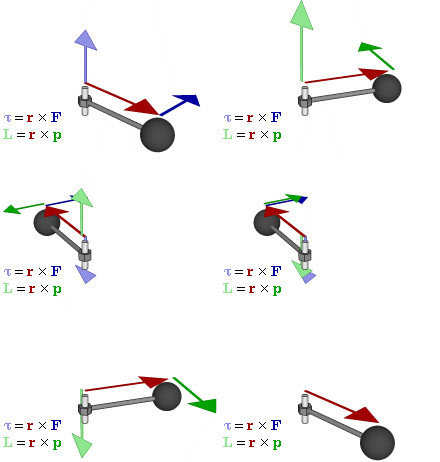
Mathematically, torque can be represented as the cross product of the force vector and the distance vector from the axis of rotation. This is often denoted as τ = r x F, where τ is the torque, r is the distance vector, and F is the force vector. The direction of the torque is perpendicular to both the force and distance vectors, and its magnitude is proportional to the product of the force and distance. This mathematical representation is essential for understanding the concept of Angular Momentum, which is a measure of an object's tendency to keep rotating.
🔧 Applications of Torque in Real-World Scenarios
Torque has numerous applications in real-world scenarios, from the simplest Screwdriver to complex Robotics systems. In automotive engineering, torque is used to describe the rotational force that an engine produces. A higher torque output means that the engine can provide more rotational force, which is essential for accelerating the vehicle. Torque is also used in Construction to describe the force required to turn a screw or bolt. The concept of torque is also closely related to the idea of Mechanical Engineering, which is used to design and develop machines and mechanisms.
🚗 Torque in Automotive Engineering
In automotive engineering, torque is a critical parameter that determines the performance of a vehicle. A higher torque output means that the vehicle can accelerate faster and tow heavier loads. However, excessive torque can also lead to Wheel Spin and loss of traction, which can be detrimental to the vehicle's stability. To mitigate this, automotive engineers use various techniques such as Torque Vectoring and Limited Slip Differential to control the torque output and improve the vehicle's handling. The concept of torque is also closely related to the idea of Vehicle Dynamics, which is used to study the motion of vehicles and their response to various inputs.
💻 Torque in Robotics and Machine Learning
In robotics and machine learning, torque is used to describe the rotational force that a robot's actuators produce. This is essential for tasks such as Grasping and Manipulation, where the robot needs to apply a specific amount of torque to interact with its environment. The concept of torque is also closely related to the idea of Control Systems, which are used to regulate the behavior of robots and other machines. Torque is also used in Computer Vision to describe the rotational force that a camera or other sensor applies to its environment.
🤔 The Relationship Between Torque and Force
The relationship between torque and force is complex and multifaceted. While force is a push or pull that causes an object to move, torque is a twist that causes an object to rotate. However, the two concepts are closely related, and a force can be converted into a torque by applying it at a distance from the axis of rotation. This is why a longer Lever can provide more torque than a shorter one, even if the same amount of force is applied. The concept of torque is also closely related to the idea of Energy, which is used to describe the capacity to do work.
📊 Calculating Torque: A Step-by-Step Guide
Calculating torque can be a complex task, especially in situations where the force and distance vectors are not perpendicular. However, by using the mathematical representation of torque, τ = r x F, engineers can calculate the torque output of a system and optimize its performance. This is essential in applications such as Aerospace Engineering, where the torque output of a system can determine its stability and performance. The concept of torque is also closely related to the idea of Materials Science, which is used to study the properties of materials and their response to various loads.
📈 The Importance of Torque in Engineering Design
The importance of torque in engineering design cannot be overstated. By understanding the concept of torque and its relationship to force and distance, engineers can design systems that are more efficient, more reliable, and more effective. This is why torque is a critical parameter in the design of Engines, Transmissions, and other mechanical systems. The concept of torque is also closely related to the idea of Mechanical Design, which is used to create detailed designs of machines and mechanisms.
🔍 Measuring Torque: Techniques and Instruments
Measuring torque is a critical task in many applications, from automotive engineering to robotics. There are various techniques and instruments available for measuring torque, including Torque Meters and Strain Gauges. By using these instruments, engineers can measure the torque output of a system and optimize its performance. The concept of torque is also closely related to the idea of Instrumentation, which is used to measure and control the behavior of systems.
📚 Historical Development of Torque Concept
The concept of torque has a long and fascinating history, dating back to the ancient Greeks. The Greek philosopher Archimedes is credited with being the first to describe the concept of torque, and his work on the subject laid the foundation for later developments in physics and engineering. Over time, the concept of torque has evolved and been refined, with contributions from scientists and engineers such as Galileo Galilei and Isaac Newton. Today, torque is a fundamental concept in physics and engineering, and its importance continues to grow as technology advances.
Key Facts
- Category
- topic
- Type
- topic
Frequently Asked Questions
What is the difference between torque and force?
Torque is the rotational correspondent of linear force, and it is a measure of the twisting or turning force that causes an object to rotate. Force, on the other hand, is a push or pull that causes an object to move. While the two concepts are related, they are distinct and have different units of measurement. Torque is measured in units of force times distance, such as newton-meters (N·m) or foot-pounds (ft·lb), while force is measured in units of mass times acceleration, such as newtons (N) or pounds (lb).
How is torque used in automotive engineering?
Torque is a critical parameter in automotive engineering, and it is used to describe the rotational force that an engine produces. A higher torque output means that the engine can provide more rotational force, which is essential for accelerating the vehicle. Torque is also used to describe the force required to turn a screw or bolt, and it is an important consideration in the design of engines, transmissions, and other mechanical systems. Automotive engineers use various techniques such as torque vectoring and limited slip differential to control the torque output and improve the vehicle's handling.
What is the relationship between torque and energy?
Torque is closely related to energy, as it is a measure of the rotational force that causes an object to rotate. The energy required to produce a certain amount of torque depends on the distance over which the force is applied, as well as the speed at which the object is rotating. In general, a higher torque output requires more energy, especially if the distance over which the force is applied is large. However, the relationship between torque and energy is complex, and it depends on various factors such as the efficiency of the system and the type of energy being used.
How is torque measured?
Torque is measured using various techniques and instruments, including torque meters and strain gauges. Torque meters are devices that measure the rotational force produced by a system, and they are commonly used in applications such as automotive engineering and robotics. Strain gauges, on the other hand, are devices that measure the deformation of a material under load, and they can be used to measure the torque output of a system. Other techniques for measuring torque include the use of load cells and pressure sensors.
What is the historical development of the concept of torque?
The concept of torque has a long and fascinating history, dating back to the ancient Greeks. The Greek philosopher Archimedes is credited with being the first to describe the concept of torque, and his work on the subject laid the foundation for later developments in physics and engineering. Over time, the concept of torque has evolved and been refined, with contributions from scientists and engineers such as Galileo Galilei and Isaac Newton. Today, torque is a fundamental concept in physics and engineering, and its importance continues to grow as technology advances.
What are some common applications of torque?
Torque has numerous applications in real-world scenarios, from the simplest screwdriver to complex robotics systems. In automotive engineering, torque is used to describe the rotational force that an engine produces. In construction, torque is used to describe the force required to turn a screw or bolt. Torque is also used in robotics and machine learning to describe the rotational force that a robot's actuators produce. Other applications of torque include the design of engines, transmissions, and other mechanical systems.
How does torque relate to mechanical advantage?
Torque is closely related to mechanical advantage, as it is a measure of the rotational force that causes an object to rotate. Mechanical advantage, on the other hand, is a measure of the ratio of the output force to the input force of a system. In general, a higher mechanical advantage means that a smaller input force can produce a larger output force, which is essential for many applications. Torque is an important consideration in the design of mechanical systems, as it can be used to amplify the force applied to an object and improve its mechanical advantage.