
Contents
- 🔍 Introduction to CT Scans
- 💻 How CT Scans Work
- 📸 CT Scan Technology
- 👨💻 The Role of Radiographers
- 🤖 Tomographic Reconstruction Algorithms
- 📊 Advantages of CT Scans
- 🚫 Contraindications and Limitations
- 🤝 Comparison with Other Imaging Techniques
- 📈 Future Developments in CT Scan Technology
- 📊 Clinical Applications of CT Scans
- 📝 Conclusion
- Frequently Asked Questions
- Related Topics
Overview
The CT scan, invented by Godfrey Hounsfield and Allan McLeod Cormack in 1971, has revolutionized medical imaging with its ability to produce detailed cross-sectional images of the body. With a vibe score of 8, this technology has become a crucial diagnostic tool, with over 80 million scans performed annually in the US alone. However, concerns over radiation exposure and high costs have sparked debates among medical professionals and patients. As technology advances, new developments such as photon-counting CT scans and artificial intelligence-powered image analysis are poised to further transform the field. The influence of key players like GE Healthcare and Siemens Healthineers will be crucial in shaping the future of CT scans. With a controversy spectrum of 6, the CT scan remains a vital component of modern medicine, with ongoing research and innovation aimed at improving its safety, efficacy, and accessibility.
🔍 Introduction to CT Scans
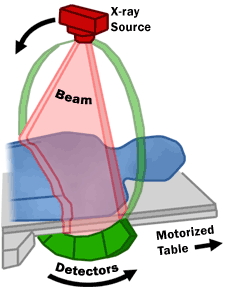
CT scans, also known as computed tomography scans, are a crucial medical imaging technique used to obtain detailed internal images of the body. This technology has revolutionized the field of medicine, allowing doctors to diagnose and treat various conditions more accurately. CT Scan technology uses a rotating X-ray tube and a row of detectors to measure X-ray attenuations by different tissues inside the body. The X-ray measurements taken from different angles are then processed on a computer using Tomographic Reconstruction Algorithms to produce tomographic (cross-sectional) images of a body. For instance, Radiology departments in hospitals rely heavily on CT scans to diagnose conditions such as Cancer and Cardiovascular Disease.
💻 How CT Scans Work
The process of a CT scan involves the patient lying on a table that slides into a large, doughnut-shaped machine called a gantry. The gantry contains the X-ray tube and detectors, which rotate around the patient to take multiple X-ray measurements from different angles. These measurements are then processed on a computer using Image Processing techniques to produce detailed images of the body. The CT Scan Machine is a complex device that requires skilled Radiographers or Radiology Technologists to operate. For example, GE Healthcare is a leading manufacturer of CT scan machines.
📸 CT Scan Technology
CT scan technology has undergone significant advancements in recent years, with the introduction of new features such as Cone Beam CT and Dual Source CT. These advancements have improved the quality and accuracy of CT scans, allowing doctors to diagnose conditions more effectively. The CT Scan Protocol is a critical aspect of the scanning process, as it determines the optimal scanning parameters for each patient. For instance, Siemens Healthineers offers a range of CT scan protocols for different clinical applications.
👨💻 The Role of Radiographers
Radiographers, also known as radiology technologists, play a vital role in the CT scanning process. They are responsible for operating the CT scan machine, positioning the patient, and ensuring that the scan is performed safely and effectively. Radiography is a specialized field that requires extensive training and expertise. Radiographers must be knowledgeable about CT Scan Safety protocols and Patient Care procedures to ensure that patients receive the best possible care. For example, the American Society of Radiologic Technologists provides guidance on CT scan safety and patient care.
🤖 Tomographic Reconstruction Algorithms
Tomographic reconstruction algorithms are a critical component of CT scan technology. These algorithms use mathematical techniques to reconstruct the X-ray measurements taken from different angles into detailed images of the body. The Reconstruction Algorithm used in CT scans is typically based on the Filtered Back Projection method. This method involves filtering the X-ray measurements to remove noise and artifacts, and then back-projecting the filtered data to produce the final image. For instance, Philips Healthcare offers a range of reconstruction algorithms for different clinical applications.
📊 Advantages of CT Scans
CT scans have several advantages over other medical imaging techniques. They are particularly useful for patients with metallic implants or pacemakers, for whom Magnetic Resonance Imaging (MRI) is contraindicated. CT scans are also faster and more comfortable for patients than MRI scans, making them a preferred choice for many clinical applications. The CT Scan Benefit is that it provides high-quality images of the body, allowing doctors to diagnose conditions more accurately. For example, University of California researchers have used CT scans to study the effects of Alzheimer's Disease on the brain.
🚫 Contraindications and Limitations
Despite the many advantages of CT scans, there are some contraindications and limitations to consider. For example, CT scans are not suitable for patients with certain types of metal implants, such as Pacemakers or Artificial Joints. Additionally, CT scans involve exposure to X-rays, which can be harmful to patients in large doses. The CT Scan Risk is that it may cause Radiation Exposure, which can increase the risk of Cancer. For instance, the National Cancer Institute provides guidance on CT scan safety and radiation exposure.
🤝 Comparison with Other Imaging Techniques
CT scans are often compared to other medical imaging techniques, such as Magnetic Resonance Imaging (MRI) and Positron Emission Tomography (PET). While MRI scans are better suited for imaging soft tissues, CT scans are more effective for imaging bones and other dense tissues. The Imaging Modality used depends on the specific clinical application and the type of tissue being imaged. For example, Johns Hopkins University researchers have used CT scans and MRI scans to study the effects of Stroke on the brain.
📈 Future Developments in CT Scan Technology
The future of CT scan technology is exciting, with many new developments on the horizon. For example, Artificial Intelligence (AI) is being used to improve the accuracy and speed of CT scans. The AI in CT technology uses machine learning algorithms to analyze CT scan data and provide more accurate diagnoses. Additionally, Cloud Computing is being used to store and analyze large amounts of CT scan data, making it easier to share and compare images. For instance, Google Cloud offers a range of cloud-based solutions for CT scan data storage and analysis.
📊 Clinical Applications of CT Scans
CT scans have a wide range of clinical applications, from diagnosing Cancer and Cardiovascular Disease to imaging Orthopedic and Neurological conditions. The CT Scan Application depends on the specific clinical need and the type of tissue being imaged. For example, Mayo Clinic researchers have used CT scans to study the effects of Diabetes on the body. CT scans are also used in Emergency Medicine to quickly diagnose and treat life-threatening conditions such as Trauma and Stroke.
📝 Conclusion
In conclusion, CT scans are a powerful medical imaging technique that has revolutionized the field of medicine. With their high-quality images and fast scanning times, CT scans are an essential tool for diagnosing and treating a wide range of conditions. As CT scan technology continues to evolve, we can expect to see even more exciting developments in the future. The CT Scan Future is bright, with many new applications and technologies on the horizon. For instance, Stanford University researchers are using CT scans to study the effects of Aging on the body.
Key Facts
- Year
- 1971
- Origin
- UK and US
- Category
- Medical Imaging
- Type
- Medical Technology
Frequently Asked Questions
What is a CT scan?
A CT scan, also known as a computed tomography scan, is a medical imaging technique used to obtain detailed internal images of the body. It uses a rotating X-ray tube and a row of detectors to measure X-ray attenuations by different tissues inside the body. The multiple X-ray measurements taken from different angles are then processed on a computer using tomographic reconstruction algorithms to produce tomographic (cross-sectional) images of a body. For example, CT Scan technology is used to diagnose conditions such as Cancer and Cardiovascular Disease.
How does a CT scan work?
A CT scan works by using a rotating X-ray tube and a row of detectors to measure X-ray attenuations by different tissues inside the body. The X-ray measurements taken from different angles are then processed on a computer using tomographic reconstruction algorithms to produce tomographic (cross-sectional) images of a body. The CT Scan Machine is a complex device that requires skilled Radiographers or Radiology Technologists to operate. For instance, GE Healthcare is a leading manufacturer of CT scan machines.
What are the advantages of CT scans?
CT scans have several advantages over other medical imaging techniques. They are particularly useful for patients with metallic implants or pacemakers, for whom Magnetic Resonance Imaging (MRI) is contraindicated. CT scans are also faster and more comfortable for patients than MRI scans, making them a preferred choice for many clinical applications. The CT Scan Benefit is that it provides high-quality images of the body, allowing doctors to diagnose conditions more accurately. For example, University of California researchers have used CT scans to study the effects of Alzheimer's Disease on the brain.
What are the limitations of CT scans?
Despite the many advantages of CT scans, there are some contraindications and limitations to consider. For example, CT scans are not suitable for patients with certain types of metal implants, such as Pacemakers or Artificial Joints. Additionally, CT scans involve exposure to X-rays, which can be harmful to patients in large doses. The CT Scan Risk is that it may cause Radiation Exposure, which can increase the risk of Cancer. For instance, the National Cancer Institute provides guidance on CT scan safety and radiation exposure.
What is the future of CT scan technology?
The future of CT scan technology is exciting, with many new developments on the horizon. For example, Artificial Intelligence (AI) is being used to improve the accuracy and speed of CT scans. The AI in CT technology uses machine learning algorithms to analyze CT scan data and provide more accurate diagnoses. Additionally, Cloud Computing is being used to store and analyze large amounts of CT scan data, making it easier to share and compare images. For instance, Google Cloud offers a range of cloud-based solutions for CT scan data storage and analysis.
What are the clinical applications of CT scans?
CT scans have a wide range of clinical applications, from diagnosing Cancer and Cardiovascular Disease to imaging Orthopedic and Neurological conditions. The CT Scan Application depends on the specific clinical need and the type of tissue being imaged. For example, Mayo Clinic researchers have used CT scans to study the effects of Diabetes on the body. CT scans are also used in Emergency Medicine to quickly diagnose and treat life-threatening conditions such as Trauma and Stroke.
How do CT scans compare to other imaging techniques?
CT scans are often compared to other medical imaging techniques, such as Magnetic Resonance Imaging (MRI) and Positron Emission Tomography (PET). While MRI scans are better suited for imaging soft tissues, CT scans are more effective for imaging bones and other dense tissues. The Imaging Modality used depends on the specific clinical application and the type of tissue being imaged. For example, Johns Hopkins University researchers have used CT scans and MRI scans to study the effects of Stroke on the brain.